Monday, August 09, 2010

How one generation loves – the next generation learns

After finishing my 30-day silent retreat in June, it took some time to get updated on what had been happening in Singapore, and also clearing all the emails that had piled up. One email I received was on the new video that the National Family Council has produced and currently showing on TV. For those of you who haven’t seen the ad, watch the video below before reading on.

This ad struck me because of the tagline at end – “How one generation loves – the next generation learns”. During my retreat, we were given many passages of the life of Jesus to pray and reflect on. And on one of the days, I was given the passage from Luke 2:39-40 to reflect on.
“When they had finished everything required by the law of the Lord, they returned to Galilee, to their own town of Nazareth. The child grew and became strong, filled with wisdom; and the favor of God was upon him.”
This passage comes after the child Jesus is presented in the Temple. After that we see Jesus as an adult at his Baptism and starting his ministry. So my Retreat Master, told me to reflect on the life of Jesus growing up. The life of Jesus from the time that he was 12 up to 30 is not talked about in the bible. So I had to imagine what Jesus did during that time.

As I was praying, an image came to me of Mother Mary teaching Jesus, his Hebrew ABCs, maybe some mathematics, and St Joseph teaching him how to use the carpentry tools. Then I imagined Mary & Joseph teaching Jesus to pray to God. This was a bit surprising and funny, because I started to wonder, would Jesus need to be taught how to pray? After all he is the Son of God. But then I thought why not? Jesus would not only have learnt how to pray from His parents, but also their example of their love of God in their lives would also have been something that He learnt as he was growing up.

This led me to reflect on my own life. And it made me think of what I have learnt from my parents. Sure they taught me how to speak, how to write, how to ride a bicycle. But more than, that I was grateful for the lessons which I learnt from the example of their lives. I learnt about the faith and how to pray. I still remember once when I asked my mum about being a godmother, and she told me how she prays for all her god-children every night. It made me wonder, if she prays for her god-children every night, how much more must she be praying for me. From them I learnt how to be generous with my time, energy and possessions. And I came out of that prayer session feeling really blessed by God for the wonderful gift of my parents.

So today I would like each one of us here to reflect on two things. Firstly, what have we learnt from our parents? What kind of values and what kind of faith have we learnt from them?

And secondly, for those of you who are parents, what are you teaching your children? Not just by what you say, but by how you live your lives. I know of parents who will tell their children to pray and to obey God. But when it comes to their children’s studies, that will come before God. The children can have many enrichment classes, but Catechism class will be the first to be sacrificed if there is a clash.

So often we hear of parents telling their children to stop watching tv or playing the computer and to do their homework. How many parents tell their children to stop doing their homework because its time to read the bible or to pray? And this is not just for parents of young children. Even if your child is an adult, parents do play a role in the salvation of their children. St Monica prayed continuously for her adult son to change his ways, and God answered his prayers, he not only converted, he became a bishop and now we know him as St Augustine.

Let us give thanks for our parents and all that they have taught and inspired us. And let us ask our blessed Mother, to help us be good Christian examples for our children, the way she was for Jesus. Amen.

Wednesday, May 12, 2010

Reflections on the Easter Season

Each year, Lent and Easter occur around the time the Spring season begins. Significant because Spring is the time of new life, when trees start to bud and flowers start to bloom. And so we too celebrate the new life that Christ has gained for us in His death and resurrection.

Spring is also the time when farmers start their sowing and planting to grow their crops to be harvested in Autumn. In preparation for the planting, the land first has to be cleared of rocks, weeds and even the crops from the previous harvest. Then the land has to be ploughed to loosen the soil hardened over the winter as well as to aerate it.

When we look at our spiritual life, this clearing and ploughing is what we do during the season of Lent, when we observe the spiritual exercises of Fasting, Prayer and Almsgiving. These help us to rid our lives of the harmful attachments in our lives as well as to open our lives to a closer relationship with God.


After the land is cleared, the farmer has to decide what crops and fruits he would like to harvest. This of course would determine what seeds he would plant in the field. But as nature has planned it, the plants that grow the quickest after the land is cleared are usually the weeds. These sprout and cover the land rapidly, blocking out sunlight and depriving the planted seeds of nutrients from the ground. Any good farmer would know that ploughing and planting is only half the job. He would have to remove the weeds, water and fertilize the plants that he has planted.

Similarly for us, in our spiritual life, our Lenten exercises are only half the job done. We too have to “plant” certain practices that will bear the fruits that we want to see in our spiritual life. Easter is that season where we start to live out that new life. Not only just planting, but we too have to be aware of the “weeds”, that were cleared during Lent, which have a quick tendency of returning into the “fields” of our lives if we are not careful.

So let this Easter be a time of planting and growing in our spiritual lives, that we may enjoy the fruits and graces that God wants to shower on us.

Thursday, March 04, 2010

Lent Seasoning

When we use the word "season" for Lent, we are usually referring to the period of fourty days of preparation before Easter. But the word "season" also bears another meaning, which the dictionary defines as "to improve and enhance the flavour of food"

I remember when I was young, there was this Maggi Seasoning in its uniquely shaped bottle, that I would add to my half boiled eggs to enhance the taste and flavour. This same seasoning was used by my mum to marinate everthing from chicken and pork to stir-fried vegetables.

It is this image of seasoning and marinating that I find relevant to the season of Lent. When we season a piece of meat before cooking, we usually cover the meat with the seasoning, making sure that it is completely covered, sometimes even rubbing or massaging so that the seasoning will go into the meat. Often we would leave the meat to soak in the seasoning to allow the flavour to soak all the way through.

Similarly when we look at our "Lenten Seasoning", we are given forty days to be "marinated" by the various Lenten Practices that we are undertaking. First what are we seasoning ourselves with? There are the 3 practices of Fasting, Almsgiving and Prayer that the Church recommends as the best seasoning. Because they help us look at 3 areas in our lives. Fasting looks at our lives and what are the things that we have allowed to take control of our lives, not just food, but other distractions or addictions. Almsgiving makes us look at others, not just about giving money, but giving our time, energy and love. And prayer of course makes us turn back to God.

Meat that is seasoned properly makes it tender, enhances the taste, and it is not just on the surface that it can be washed away. So too our Lenten Seasoning, has to be something that transforms us internally. The effects of our fasting cannot be that we lose weight, but are we tempering our desires and feelings. Our almsgiving cannot result just in a lighter wallet, but are we more aware of the needs of others and growing in our relationships. And our prayer has to result in an increase in our relationship and love of God. Though we will stop our lenten practices at Easter, the effects of a properly "seasoned" person will continue in the lives we lead.

So let us pray that our Lenten Seasoning this year may not just be "garnishing" that is put on externally and just looks nice, but that it will truly transform us within to be tastier, tender and holier when we celebrate the gift of New Life at Easter.

Friday, February 26, 2010

Are our Radios Tuned?

In the recent Superbowl, Budweiser came up with and advertisement about a group of plane crash survivors stranded on a deserted island. One of them managed to salvage the plane's radio, and there seems to be a glimmer of hope that they can make send out a distress signal and be rescued from the island.


Link http://www.youtube.com/watch?v=TjPDlAroblI

But another guy finds the plane's beverage cart, and it is filled with Budweiser beer. And we see the group lose interest in the radio, and start to drink, party and have fun. Budweiser probably intended the ad to emphasise on how beer brings fun and enjoyment in the now moment. But I don't think they realise that it also sends a message that beer drinking distracts people from the important things in life - Here being to be rescued off the island.

The ad reflects the current day mindset and culture that is being promoted, spend the money that you have earned or even before you earn it. Enjoy the pleasures of life. Live in the Now, let tomorrow worry about itself. Just like how just as the woman got the radio working, the guy tunes it to play music to liven up the party. The ad might seem funny and exaggerated, yet its scary how real it can reflect the lifestyle we are living, where we let ourselves be "controlled" by our need for "pleasure".

In life we can sometimes get distracted by the needs and pleasure of the present moment, and forget about the important thing in life - God and his promise of salvation. That there is a "tomorrow" that we are looking ahead, and not just about enjoying the "Today". It is thus that our Lenten practices help us to realise how we are controlled by our needs and pleasure. Fasting helps us to transcend our fleshly desires, Almsgiving helps us to not be ego-centric and to think of others in need, and Prayer helps us to remember God our salvation and our final destination.

Now that we are 10 days into Lent, lets look at what Lenten practices we have undertaken, and whether they are helping us to be in control of our earthly desires, and tune our "radios" to the salvation that God has graced us with.

Repent and Blog


This Non Sequitur comic in the papers last week prompted me to blog again. I'm not really sure why the comic linked "repent" to blogging, but it did remind me that it is maybe it is time for me to blog again this Lent. Starting with some sharings that I did for Lauds and Vespers in the seminary, and also hopefully finish up the reflections on the "Last Seven Words of Christ" that I posted up for last year's Holy Week.

Thursday, December 17, 2009

That Dreaded Time of the Year

Yes its Christmas in a weeks time.
Which also means its the time when parishes are having the penitential services.
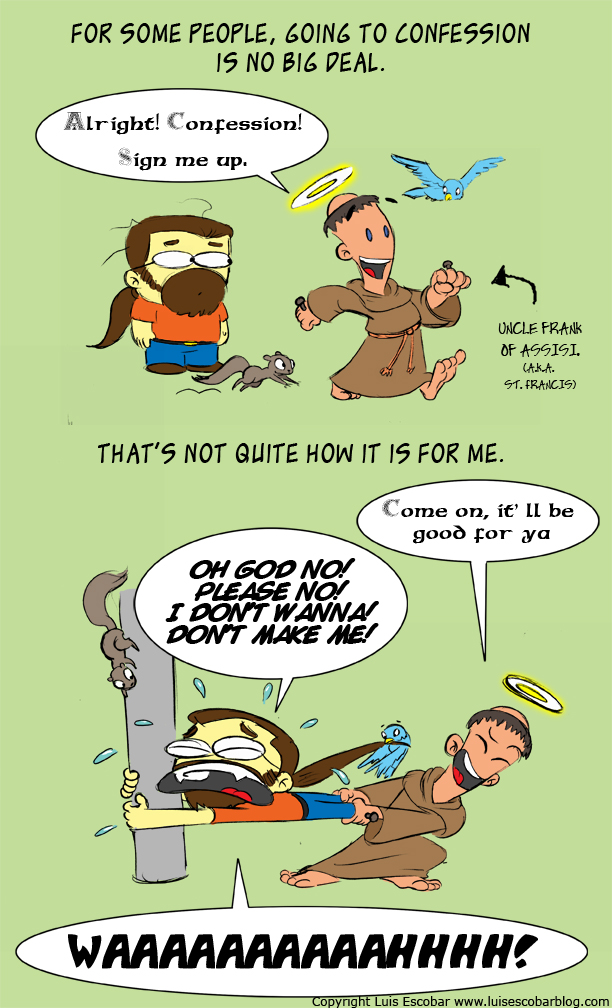
For some going for confession is like the dreaded exams that we have before we can enjoy the holidays.
Why do we have to go for confession twice a year before Christmas and Easter.

Fr Luke Fong started his blog two months ago, where he puts up his reflections once a week. And in his latest post he comments about the sacrament of reconciliation. He uses a story about "Sally and the Pearls" to explain the purpose and beauty behind the sacrament.

For myself, I too used to find it so difficult to go for confession. But after my wake-up call, I started to question all the rituals and practices I followed as a Catholic. And confessions was one of the hardest to come to terms with.

I remember there was the comparison of confession with taking a bath. Where we have to wash away our sins regularly. But somehow that analogy just did not cut it, or make me want to go for it any more than I had to.

It took me many years, but I finally realised how to make sense of confessions. And the answer did not lie in the confession itself, but in my understanding of our faith.

For most of my life, I have come to understand sin as bad actions, with bad consequences to the party that I've sinned against and also to myself because God does not like sin. But as I grew in my faith, I realised that its so easy to get caught up in the religious practices and the rules and regulations of the faith, that I was not aware that the most important element of being a Catholic is my relationships, with God and with those around me. That is why it is a faith more than a religion.

It is only when I started to look at Catholic faith from the relationship aspect, then I realised that sin wasn't so much a bad action, but anything that breaks my relationship with God, and others. And thus comes the Sacrament of Reconciliation.

Too often we call it confession, which highlights just the act of confessing our sins, but we miss out the elements of repentence, and more often that it is a restoration of our broken relationship with God.

These days, I still have the uneasy feeling when I have to make my confession, because of the shame of sin and having to confront my own weakness. But what drives me to go for it regularly, is not about being washed clean from being dirty, but of how important do I see my relationship with God, and am I willing to confront the broken relationship and allow restoration and healing to take place.

I found this interesting cartoon on this guy's blog


I especially like this quote of his

I once heard somewhere that Confession is like the direct opposite of sinning. When you sin, you tend to want to do it, you feel good doing it, and you feel bad after. Confession, on the other hand, you don’t want to do it, you feel bad doing it, and you feel awesome after. I’d much rather go to Confession.

Monday, November 16, 2009

Offering video by eXcess

The eXcess Youth Ministry in Christ the King recently posted up a video that was made by their Media Team. Quite a simple theme and very catchy background song.


Youtube Link to watch the video

It brought to mind the movie Pay It Forward where one act of kindness results in another act, and it goes on and on. Ironically I also saw an ad today titled "It all comes back to you", on how our bad acts can eventually come back to haunt us.


Youtube Link to watch the video

So the question is, are we passing on acts of love, care and kindness or acts of hate, anger, selfishness?